What assumptions let us recover the ATT?
ECON 730: Causal Inference with Panel Data
Lecture 5: Introduction to Difference-in-Differences
Pedro H. C. Sant’Anna
Emory University
Spring 2026
From Experiments to Observational Studies
Roadmap
Lectures 3–4: Causal inference with randomized panel experiments
- Design-based identification; Horvitz–Thompson estimation
- Known treatment assignment mechanism \(\Rightarrow\) clear identification
Today: What if treatment is not randomized?
Our approach:
- The canonical \(2 \times 2\) difference-in-differences (DiD) setup
- Two groups (treated vs. untreated), two periods (pre vs. post)
- Replace randomization with parallel trends assumption
The full journey today:
- Setup \(\to\) Identification \(\to\) Estimation \(\to\) Inference \(\to\) Application
The Challenge: Selection into Treatment
- In observational studies, units select into treatment
- States choose to expand Medicaid; firms decide to adopt new technology
- Simple pre–post or treated-vs.-untreated comparisons are biased
- Treated units may differ from comparison units even without treatment
- Difference-in-Differences (DiD): Exploit the time dimension
- Use pre-treatment periods to account for selection concerns, as long as additional assumptions (Parallel Trends, No-Anticipation) are met
- The most widely used identification strategy in applied microeconomics
- See Lecture 1; (Currie, Kleven, and Zwiers 2020; Goldsmith-Pinkham 2024)
The \(2 \times 2\) DiD Setup
Running Example: Medicaid Expansion and Mortality
Baker et al. (2025): A Practitioner’s Guide to Difference-in-Differences
Policy: Affordable Care Act (ACA) Medicaid expansion
- 2014: Some states expand eligibility \(\to\) more residents gain health insurance
- Other states never expand (through 2019)
Outcome: County-level mortality rate (ages 20–64), deaths per 100,000
Question: Did Medicaid expansion reduce mortality?
\(2 \times 2\) Setup:
- Two periods: 2013 (pre) and 2014 (post)
- Two groups: States expanding in 2014 vs. never-expanding states
- Unit of observation: Counties within states
Data Structure: Two Groups, Two Periods
Time periods: \(t \in \{1, 2\}\) (e.g., 2013 and 2014)
Treatment group indicator: \(G_i \in \{2, \infty\}\)
- \(G_i = 2\): unit \(i\) is first treated at period 2 (expansion states)
- \(G_i = \infty\): unit \(i\) is never treated (never-expansion states)
Treatment indicator: \(D_{i,t} = \mathbf{1}\{G_i \leq t\}\)
- \(D_{i,1} = 0\) for all units (no one is treated at \(t=1\))
- \(D_{i,2} = \mathbf{1}\{G_i = 2\}\) (only the treated group at \(t=2\))
Key features:
- Treatment is binary and absorbing (once treated, stay treated)
- No one is treated in the first period
- This is the simplest DiD setup — building block for everything else
Potential Outcomes in the \(2 \times 2\) Setup
Recall from Lecture 2: potential outcomes indexed by treatment sequence
Specialize to \(2 \times 2\): Only two possible treatment paths
- \(Y_{i,t}(\infty)\): outcome if unit \(i\) is never treated (untreated potential outcome)
- \(Y_{i,t}(2)\): outcome if unit \(i\) is first treated at \(t=2\)
SUTVA (Stable Unit Treatment Value Assumption):
- No interference: unit \(i\)’s outcome depends only on \(i\)’s own treatment path
- No hidden versions of treatment
Observed outcome: \[ Y_{i,t} = \mathbf{1}\{G_i = 2\} \cdot Y_{i,t}(2) + \mathbf{1}\{G_i = \infty\} \cdot Y_{i,t}(\infty) \]
This is the same potential outcomes framework from Lectures 2–4, just specialized to two groups and two periods
Target Parameter: The Average Treatment Effect on the Treated
Parameter of interest: The ATT at period 2 \[ ATT \;=\; \mathbb{E}\big[Y_{i,t=2}(2) - Y_{i,t=2}(\infty) \;\big|\; G_i = 2\big] \]
Interpretation:
- Average causal effect of treatment for those who are actually treated
- Not the ATE — we condition on \(G_i = 2\)
In the Medicaid example:
- Average effect of Medicaid expansion on mortality in counties that expanded
- Not: what would happen if all counties expanded
The fundamental problem: We observe \(Y_{i,t=2}(2)\) for the treated group, but we never observe \(Y_{i,t=2}(\infty)\) for the treated group
How do we impute the missing counterfactual?
The DiD Estimand: A Preview
- The DiD estimand takes the form:
\[ \theta^{DiD} = \Big(\mathbb{E}[Y_{i,t=2} | G_i = 2] - \mathbb{E}[Y_{i,t=1} | G_i = 2]\Big) - \Big(\mathbb{E}[Y_{i,t=2} | G_i = \infty] - \mathbb{E}[Y_{i,t=1} | G_i = \infty]\Big) \]
- Four observable group-period means; treated group’s change minus comparison group’s change
Two fundamental questions for the rest of this lecture:
- How do we arrive at this estimand? Why this particular form?
- Under what assumptions does \(\boldsymbol{\theta^{DiD} = ATT}\)? Why?
Selection Bias and the Missing Data Problem
The Missing Data Problem: Under SUTVA
- SUTVA \(\Rightarrow\) each unit reveals outcomes from its own treatment path only
- What do we observe vs. what is missing?
| \(Y_{i,t=1}(\infty)\) | \(Y_{i,t=1}(2)\) | \(Y_{i,t=2}(\infty)\) | \(Y_{i,t=2}(2)\) | |
|---|---|---|---|---|
| \(G_i = 2\) (Treated) | ? | \(\checkmark\) | ? | \(\checkmark\) |
| \(G_i = \infty\) (Comparison) | \(\checkmark\) | ? | \(\checkmark\) | ? |
- Treated units reveal \(Y_{i,t}(2)\); comparison units reveal \(Y_{i,t}(\infty)\)
- Problem: The ATT requires \(\mathbb{E}[Y_{i,t=2}(\infty) | G_i = 2]\) — a missing cell!
- Can we learn more using No-Anticipation?
Filling In: Adding No-Anticipation
- No-Anticipation \(\Rightarrow\) \(Y_{i,t=1}(2) = Y_{i,t=1}(\infty)\) for all \(i\) (can be relaxed to hold on average among treated)
- So for treated units at \(t=1\): \(Y_{i,t=1} = Y_{i,t=1}(2) = Y_{i,t=1}(\infty)\) — both potential outcomes observed!
| \(Y_{i,t=1}(\infty)\) | \(Y_{i,t=1}(2)\) | \(Y_{i,t=2}(\infty)\) | \(Y_{i,t=2}(2)\) | |
|---|---|---|---|---|
| \(G_i = 2\) (Treated) | \(\checkmark\)* | \(\checkmark\) | ? | \(\checkmark\) |
| \(G_i = \infty\) (Comparison) | \(\checkmark\) | — | \(\checkmark\) | — |
*Same as \(Y_{i,t=1}(2)\) under No-Anticipation
- The one remaining missing cell: \(\mathbb{E}[Y_{i,t=2}(\infty) | G_i = 2]\) — the counterfactual for the treated group at \(t=2\)
Selection Bias in the Post-Treatment Comparison
- Naive approach: Compare treated and comparison at \(t=2\)
\[ \begin{aligned} &\mathbb{E}[Y_{i,t=2} | G_i = 2] - \mathbb{E}[Y_{i,t=2} | G_i = \infty] \\[6pt] &= \mathbb{E}[Y_{i,t=2}(2) | G_i = 2] - \mathbb{E}[Y_{i,t=2}(\infty) | G_i = \infty] \\[6pt] &= \underbrace{\mathbb{E}[Y_{i,t=2}(2) - Y_{i,t=2}(\infty) | G_i = 2]}_{ATT} + \underbrace{\mathbb{E}[Y_{i,t=2}(\infty) | G_i = 2] - \mathbb{E}[Y_{i,t=2}(\infty) | G_i = \infty]}_{\color{#b91c1c}{\text{Selection Bias}}} \end{aligned} \]
- The selection bias reflects differences in untreated potential outcomes between groups at \(t=2\)
Worked Example: Job Training Program
- Setting: Job training for disadvantaged workers — workers with lower baseline wages select into the program
| Unit | \(Y_{i,t=1}(\infty)\) | Wage | \(Y_{i,t=2}(\infty)\) | \(Y_{i,t=2}(2)\) |
|---|---|---|---|---|
| A (Trained) | 20 | 20 | 22 | 27 |
| B (Trained) | 18 | 18 | 20 | 24 |
| C (Not trained) | 30 | 30 | 32 | — |
| D (Not trained) | 28 | 28 | 30 | — |
- True ATT $= = $ 4.5
- Naive: $ - = 25.5 - 31 = $ -5.5 — Selection bias \(= -10\)
Selection bias contaminates naive comparisons.
Assumptions: No-Anticipation and Parallel Trends
Assumption: No Anticipation
Our first assumption ensures that future treatment does not contaminate pre-treatment outcomes:
No-Anticipation. For all units \(i\): \(Y_{i,t=1}(2) = Y_{i,t=1}(\infty)\). Treatment at \(t=2\) has no effect on outcomes at \(t=1\).
For ATT identification, we only need this on average across treated units: \(\mathbb{E}[Y_{i,t=1}(2) | G_i = 2] = \mathbb{E}[Y_{i,t=1}(\infty) | G_i = 2]\)
- Interpretation: Agents do not change behavior before treatment begins
- When it holds: Unexpected policy changes; units unaware of future treatment
- When it fails: Pre-announced policies \(\to\) behavioral adjustments before implementation (Malani and Reif 2015)
- Notational simplification: Under No-Anticipation, \(Y_{i,t=1} = Y_{i,t=1}(\infty)\) for all units
Assumption: Parallel Trends
Parallel Trends (PT). \[ \mathbb{E}[Y_{i,t=2}(\infty) - Y_{i,t=1}(\infty) \;|\; G_i = 2] = \mathbb{E}[Y_{i,t=2}(\infty) - Y_{i,t=1}(\infty) \;|\; G_i = \infty]. \]
- What PT says:
- In the absence of treatment, both groups would have followed the same trend
- Allows for permanent level differences between groups
- What PT does NOT require:
- Same levels of outcomes: \(\mathbb{E}[Y_{i,t}(\infty) | G_i = 2] \neq \mathbb{E}[Y_{i,t}(\infty) | G_i = \infty]\) is fine!
- Random treatment assignment or no selection into treatment
- What PT rules out: Differential time-varying selection — trends in untreated outcomes differ by group
This PT involves counterfactual outcomes \(\Rightarrow\) fundamentally untestable. We can assess plausibility using pre-treatment data (in a few lectures).
Parallel Trends: Graphical Intuition (1/4)
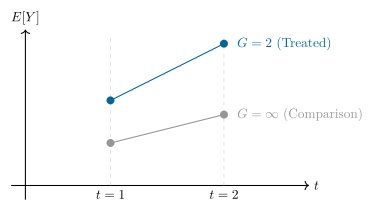
- Treated group has higher levels and rises more from \(t=1\) to \(t=2\)
- But how much of the rise is due to treatment?
Parallel Trends: Graphical Intuition (2/4)
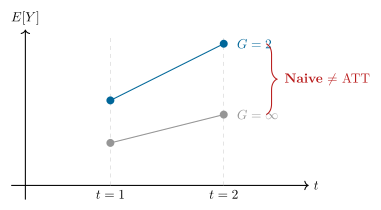
- The naive comparison at \(t=2\) includes the level difference that existed before treatment
- This is selection bias \(+\) treatment effect, mixed together
Parallel Trends: Graphical Intuition (3/4)
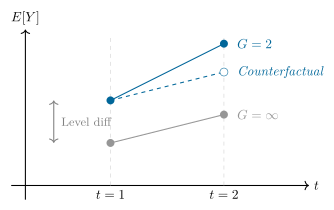
- Under PT: the treated group’s counterfactual trajectory is parallel to the comparison group
- The hollow circle is the missing counterfactual \(\mathbb{E}[Y_{i,t=2}(\infty) | G_i = 2]\)
Parallel Trends: Graphical Intuition (4/4)
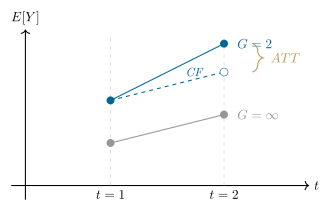
- ATT \(=\) (Treated group’s change) \(-\) (Comparison group’s change) \(=\) Difference-in-Differences
- Think: What would this diagram look like if Parallel Trends fails?
When Is Parallel Trends Plausible?
PT is fundamentally untestable — it concerns counterfactual trends, not observed trends
Suggestive evidence: Pre-treatment trends can provide support
- If expansion and non-expansion states had similar mortality trends before 2014, PT is more credible
- But parallel pre-trends \(\neq\) parallel trends (Roth 2022; Ghanem, Sant’Anna, and Wüthrich 2026)
Potential violations in the Medicaid example:
- Opioid crisis differentially affected states — could confound mortality trends
- Expansion states may have had different health infrastructure investments
Best practice: Argue for PT using institutional knowledge, not just pre-trend tests. We will revisit this in future lectures
Identification of the ATT
Constructive Imputation: Step by Step
Goal: Show that \(\theta^{DiD} = ATT\) under SUTVA + No-Anticipation + PT.
Start from the ATT:
\[ ATT = \underbrace{\mathbb{E}[Y_{i,t=2}(2) | G_i = 2]}_{\color{#15803d}{\text{observable}}} - \underbrace{\mathbb{E}[Y_{i,t=2}(\infty) | G_i = 2]}_{\color{#b91c1c}{\text{counterfactual}}} \]
Use PT to impute the counterfactual:
\[ \mathbb{E}[Y_{i,t=2}(\infty) | G_i = 2] = \mathbb{E}[Y_{i,t=1}(\infty) | G_i = 2] + \mathbb{E}[Y_{i,t=2}(\infty) | G_i = \infty] - \mathbb{E}[Y_{i,t=1}(\infty) | G_i = \infty] \]
Under No-Anticipation + SUTVA, all terms are observable:
\[ \mathbb{E}[Y_{i,t=2}(\infty) | G_i = 2] = \underbrace{\mathbb{E}[Y_{i,t=1} | G_i = 2]}_{\color{#15803d}{\checkmark\; \text{No-Anticipation}}} + \underbrace{\mathbb{E}[Y_{i,t=2} | G_i = \infty] - \mathbb{E}[Y_{i,t=1} | G_i = \infty]}_{\color{#15803d}{\checkmark\; \text{all observable}}} \]
The DiD Identification Result
Theorem (DiD Identification). Under SUTVA, No-Anticipation, and Parallel Trends: \[ ATT = \theta^{DiD} = \Big(\mathbb{E}[Y_{i,t=2} | G_i = 2] - \mathbb{E}[Y_{i,t=1} | G_i = 2]\Big) - \Big(\mathbb{E}[Y_{i,t=2} | G_i = \infty] - \mathbb{E}[Y_{i,t=1} | G_i = \infty]\Big) \]
- Three assumptions \(\Rightarrow\) observable formula with four population means
- Note: This is an identification result, not an estimation result
- The formula involves population expectations, not sample averages
- Estimation comes next
Weighted Expectations: Who Defines the Parameter?
Baker et al. (2025) emphasize: the weights define the ATT
Unweighted DiD:
\[ATT = \mathbb{E}[Y_{i,t=2}(2) - Y_{i,t=2}(\infty) | G_i = 2]\]
- Each unit gets equal weight
- “Average effect per county”
Population-weighted DiD:
\[ATT_\omega = \mathbb{E}_\omega[Y_{i,t=2}(2) - Y_{i,t=2}(\infty) | G_i = 2]\]
- Weight by population \(\omega_i\)
- “Average effect per person”
Key message: Both are valid ATTs, but they answer different questions
- The choice of weights is a substantive decision, not a statistical one
- The choice of weights also impacts the PT assumption!
We know what to estimate.
Now: how to estimate and do inference.
Estimation
The Analogy Principle
- Identification: \(ATT = f(\text{population means})\)
- Estimation: Replace population means with sample analogs
- Notation:
- \(n\): total sample size; \(n_2\): treated units; \(n_\infty\): comparison units
- \(\bar{Y}_{g,t} = \frac{1}{n_{g}} \sum_{i:\, G_i = g} Y_{i,t}\): sample mean for group \(g \in \{2, \infty\}\) at time \(t\)
- The DiD estimator (“DiD-by-hand”):
\[ \widehat{\theta}^{DiD} = \big(\bar{Y}_{g=2,t=2} - \bar{Y}_{g=2,t=1}\big) - \big(\bar{Y}_{g=\infty,t=2} - \bar{Y}_{g=\infty,t=1}\big) \]
- Simply the difference of two within-group time changes
- With panel data, this simplifies further…
Panel Data Simplification: First-Differencing
With panel data (same units in both periods), define \(\Delta Y_i = Y_{i,t=2} - Y_{i,t=1}\)
The DiD estimator as a two-sample difference in means: \[ \widehat{\theta}^{DiD} = \overline{\Delta Y}_2 - \overline{\Delta Y}_\infty = \frac{1}{n_2} \sum_{i:\, G_i = 2} \Delta Y_i - \frac{1}{n_\infty} \sum_{i:\, G_i = \infty} \Delta Y_i \]
Two steps:
- First-difference \(\Rightarrow\) removes time-invariant unit effects
- Compare treated vs. comparison changes
Requires panel data:
- Same units observed in both periods
- With repeated cross-sections, use the four-means formula
Notation: Treatment Indicator for Regressions
We use \(G_i\) notation consistently for conditioning and parameters: \(ATT = \mathbb{E}[Y_{i,t=2}(2) - Y_{i,t=2}(\infty) \;|\; G_i = 2]\)
For regression and influence function formulas, define a binary shorthand: \[ D_i = \mathbf{1}\{G_i = 2\} = \begin{cases} 1 & \text{if unit } i \text{ is in the treated group} \\ 0 & \text{if unit } i \text{ is in the comparison group} \end{cases} \]
Why this convention?
- \(G\)-notation generalizes naturally to staggered adoption
- \(D_i\) is convenient in regression equations where we need 0/1 arithmetic
Rule: All conditioning, parameters, and potential outcomes use \(G_i\); \(D_i\) appears only in regression specifications and influence function formulas
TWFE Regression
A common way to estimate DiD: Two-Way Fixed Effects (TWFE) regression
Pooled OLS form:
\[Y_{i,t} = \alpha_0 + \gamma_0 D_i + \lambda_0 T_t + \beta^{TWFE} (D_i \times T_t) + \varepsilon_{i,t}\]
where \(T_t = \mathbf{1}\{t = 2\}\), \(D_i = \mathbf{1}\{G_i = 2\}\)
Unit & time FE form:
\[Y_{i,t} = \alpha_i + \lambda_t + \beta^{TWFE} D_{i,t} + \varepsilon_{i,t}\]
where \(D_{i,t} = \mathbf{1}\{G_i \leq t\}\)
- Both are equivalent in the \(2 \times 2\) case with balanced panel data — same \(\hat{\beta}^{TWFE}\)
- Key question: Does \(\hat{\beta}^{TWFE} = \widehat{\theta}^{DiD}\)?
- Answer: Yes! In the \(2 \times 2\) case, they are numerically identical
TWFE = DiD-by-Hand: The Equivalence
- Claim: \(\hat{\beta}^{TWFE} = \widehat{\theta}^{DiD}\) (exact numerical equality)
- Proof sketch: OLS solves four moment conditions:
\[ \begin{aligned} \mathbb{E}_n[\varepsilon_{i,t}] &= 0 & &\Rightarrow \hat{\alpha}_0 = \bar{Y}_{g=\infty,t=1} \\ \mathbb{E}_n[D_i \cdot \varepsilon_{i,t}] &= 0 & &\Rightarrow \hat{\gamma}_0 = \bar{Y}_{g=2,t=1} - \bar{Y}_{g=\infty,t=1} \\ \mathbb{E}_n[T_t \cdot \varepsilon_{i,t}] &= 0 & &\Rightarrow \hat{\lambda}_0 = \bar{Y}_{g=\infty,t=2} - \bar{Y}_{g=\infty,t=1} \\ \mathbb{E}_n[(D_i \cdot T_t) \cdot \varepsilon_{i,t}] &= 0 & &\Rightarrow \hat{\beta}^{TWFE} = \widehat{\theta}^{DiD} \end{aligned} \]
- The four moment conditions uniquely pin down the four group-time means
- Bottom line: In the \(2 \times 2\) case, TWFE regression is just a convenient way to compute the DiD estimator. Nothing more, nothing less.
- Every student in this class should be able to derive these equivalence results!
- Think: Will this equivalence survive when we move to staggered adoption? Why or why not?
Three Equivalent Specifications
Baker et al. (2025): Three OLS specifications, same \(\hat{\beta}\)
| Spec | Regression | Data Used |
|---|---|---|
| (1) Pooled OLS | \(Y_{i,t} = \alpha + \gamma D_i + \lambda T_t + \beta (D_i \cdot T_t) + \varepsilon_{i,t}\) | Panel (\(2n\) obs) |
| (2) First-diff | \(\Delta Y_i = \delta + \beta D_i + u_i\) | Panel, FD (\(n\) obs) |
| (3) Unit & time FE | \(Y_{i,t} = \alpha_i + \lambda_t + \beta D_{i,t} + \varepsilon_{i,t}\) | Panel (\(2n\) obs) |
- All three yield identical point estimates for \(\hat{\beta}\) in the \(2 \times 2\) case with balanced panel
- BUT: Standard errors differ unless you cluster appropriately!
- Spec (1) and (3) have \(2n\) observations; Spec (2) has \(n\) observations
- Clustering at the unit level in Specs (1) and (3) reconciles the SEs
OLS: Regression as a Means to an End
Important conceptual point: The regression is a computational device
In the \(2 \times 2\) case, OLS does not add any statistical content
- Same estimate as computing four means and subtracting
- The interpretation comes from the DiD identification argument, not from the regression
Why use regression then?
- Convenience: standard software handles SEs and clustering
- Reporting: tables with coefficients and SEs are standard in economics
Warning for later: In more complex settings (staggered adoption, heterogeneous effects), TWFE \(\neq\) “the” DiD estimator
- The \(2 \times 2\) equivalence is special and does not generalize
- Recall Lecture 3: FE can be biased under carryover effects. Here, with no carryover in the \(2 \times 2\) case, TWFE is well-behaved
Empirical Application: Medicaid Expansion
Application: The ACA and County Mortality
Data: County-level mortality rates (ages 20–64), deaths per 100,000
- Source: Baker et al. (2025), replication data from
pedrohcgs/JEL-DiD
- Source: Baker et al. (2025), replication data from
Treatment: State-level Medicaid expansion under the ACA
- 24 states + DC expanded in January 2014
- 19 states never expanded (through 2019)
- Drop DC and pre-2014 adopters (DE, MA, NY, VT) for clean \(2 \times 2\)
\(2 \times 2\) Setup:
- Pre: 2013, Post: 2014
- Treated: Counties in states expanding in 2014
- Comparison: Counties in never-expanding states
Sample: $$2,300 counties, roughly 900 treated and 1,400 comparison
Key feature: Counties vary enormously in population size — weighting matters!
Simple \(2 \times 2\) Results: Unweighted vs. Weighted
Baker et al. (2025), Table 2: Simple means and DiD
| Pre (2013) | Post (2014) | Pre (2013) | Post (2014) | |
|---|---|---|---|---|
| Unweighted | Pop-Weighted | |||
| Treated (\(G_i=2\)) | 419.2 | 428.5 | 322.7 | 326.5 |
| Comparison (\(G_i=\infty\)) | 474.0 | 483.1 | 376.4 | 382.7 |
| \(\Delta\) Treated | +9.3 | +3.7 | ||
| \(\Delta\) Comparison | +9.1 | +6.3 | ||
| DiD | +0.1 | $-$2.6 |
- Unweighted: DiD \(\approx +0.1\) (SE \(= 3.7\)) (essentially zero, “wrong sign”)
- Population-weighted: DiD \(\approx -2.6\) (SE \(= 1.5\)) (meaningful reduction in mortality)
- Why the difference? Different parameters! “Per county” vs. “per person” ATT
Regression Equivalence: Three Specifications
- All three specifications yield the same point estimate (county-clustered SEs)
| (1) Pooled OLS | (2) First-diff | (3) Unit & time FE | |
|---|---|---|---|
| \(\hat{\beta}\) (unweighted) | 0.1 | 0.1 | 0.1 |
| SE (county-clustered) | (3.7) | (3.7) | (3.7) |
| \(\hat{\beta}\) (pop-weighted) | $-$2.6 | $-$2.6 | $-$2.6 |
| SE (county-clustered) | (1.5) | (1.5) | (1.5) |
| Observations | \(2n\) | \(n\) | \(2n\) |
- Point estimates are identical across all three specifications
- County-clustered SEs are also identical (as expected from theory)
- Neither result is statistically significant at conventional levels
R Code: DiD by Hand vs. Regression
DiD by hand:
- Both approaches give identical estimates
short_data: balanced panel with 2013–2014 only (the \(2 \times 2\) subset)- Full replication code:
github.com/pedrohcgs/JEL-DiD
Key Takeaway: Weights Matter
Lesson from the Medicaid application:
- The choice of weights (unweighted vs. population-weighted) changes the target parameter
- Unweighted DiD: $ = $ +0.1 (“per county” ATT)
- Weighted DiD: $ = $ -2.6 (“per person” ATT)
- Both are valid, but they answer different questions
- Why this matters going forward:
- When we add covariates, conditioning variables implicitly change weights
- Different estimators (regression adjustment, IPW, doubly robust) target the same parameter but may use different implicit weights
- Researcher’s responsibility: Be explicit about what parameter you are estimating
We have seen DiD work in practice.
Now: what are its statistical properties?
Influence Functions and Asymptotic Theory
Why Influence Functions?
Having seen DiD work in practice, we now formalize the statistical properties of the estimator.
- We have an estimator \(\widehat{\theta}^{DiD}\). What are its large-sample properties?
- Goals: Consistency, asymptotic normality, variance estimation, and valid bootstrap inference
- Influence functions provide a unified approach:
- Decompose the estimator as a sum of iid terms (+ remainder)
- The influence function \(\psi_i\) captures unit \(i\)’s contribution to the estimator
- Variance of the IF \(=\) asymptotic variance of \(\widehat{\theta}^{DiD}\)
- This framework generalizes naturally to more complex estimators (covariates, staggered designs) in later lectures
Panel Data Sampling Scheme
Panel Data Sampling. We observe an iid random sample \(\{Z_i\}_{i=1}^n\) where \(Z_i = (Y_{i,t=1}, Y_{i,t=2}, G_i)\) is drawn from the joint distribution of \((Y_{i,t=1}, Y_{i,t=2}, G_i)\).
- The same \(n\) units are observed in both periods (\(t=1\) and \(t=2\))
- Key: Units are iid across \(i\), but \(Y_{i,t=1}\) and \(Y_{i,t=2}\) are not independent within unit
- This allows us to compute \(\Delta Y_i = Y_{i,t=2} - Y_{i,t=1}\) for each unit
- Let \(D_i = \mathbf{1}\{G_i = 2\}\) and \(p = \Pr(G_i = 2) \in (0,1)\)
- Notation: \(\mathbb{E}_n[f(Z_i)] = \frac{1}{n}\sum_{i=1}^n f(Z_i)\) denotes the sample average
The DiD Estimator as a Function of Means
Write the DiD estimator using empirical expectations: \[ \widehat{\theta}^{DiD} = \frac{\mathbb{E}_n[\Delta Y_i \cdot D_i]}{\mathbb{E}_n[D_i]} - \frac{\mathbb{E}_n[\Delta Y_i \cdot (1 - D_i)]}{\mathbb{E}_n[1 - D_i]} \]
This is a smooth function of sample means: \(\widehat{\theta}^{DiD} = g(\mathbb{E}_n[\mathbf{m}(Z_i)])\)
where \(\mathbf{m}(Z_i) = (\Delta Y_i \cdot D_i, \; D_i, \; \Delta Y_i \cdot (1-D_i), \; 1 - D_i)'\)
By the Law of Large Numbers: \(\mathbb{E}_n[\mathbf{m}(Z_i)] \xrightarrow{p} \mathbb{E}[\mathbf{m}(Z_i)]\)
By the Continuous Mapping Theorem: \(\widehat{\theta}^{DiD} = g(\mathbb{E}_n[\mathbf{m}(Z_i)]) \xrightarrow{p} g(\mathbb{E}[\mathbf{m}(Z_i)]) = \theta^{DiD}\)
\(\Rightarrow\) Consistency follows from LLN + CMT
Asymptotic Normality: Setup
Apply the delta method to \(g(\mathbb{E}_n[\mathbf{m}(Z_i)])\): \[ \sqrt{n}(\widehat{\theta}^{DiD} - \theta^{DiD}) = \sqrt{n} \cdot \nabla g(\boldsymbol{\mu})' \big(\mathbb{E}_n[\mathbf{m}(Z_i)] - \boldsymbol{\mu}\big) + o_p(1) \] where \(\boldsymbol{\mu} = \mathbb{E}[\mathbf{m}(Z_i)]\)
By the CLT: \[ \sqrt{n}\big(\mathbb{E}_n[\mathbf{m}(Z_i)] - \boldsymbol{\mu}\big) \xrightarrow{d} N(\mathbf{0}, \text{Var}(\mathbf{m}(Z_i))) \]
Combining (Slutsky): \[ \sqrt{n}(\widehat{\theta}^{DiD} - \theta^{DiD}) \xrightarrow{d} N\big(0, \;\nabla g(\boldsymbol{\mu})' \text{Var}(\mathbf{m}(Z_i)) \nabla g(\boldsymbol{\mu})\big) \]
This can be written more compactly using the influence function…
The Influence Function: Panel Data Case
Panel data IF. Under the panel data sampling scheme: \[ \psi_i^{p} = \underbrace{\frac{D_i}{p}}_{w_1(D_i)} \big(\Delta Y_i - \mu_{\Delta,2}\big) \;-\; \underbrace{\frac{1 - D_i}{1 - p}}_{w_0(D_i)} \big(\Delta Y_i - \mu_{\Delta,\infty}\big) \] where \(p = \Pr(G_i = 2)\), \(\mu_{\Delta,g} = \mathbb{E}[\Delta Y_i | G_i = g]\) for \(g \in \{2,\infty\}\).
- Key property: \(\sqrt{n}(\widehat{\theta}^{DiD} - \theta^{DiD}) = \frac{1}{\sqrt{n}} \sum_{i=1}^n \psi_i^p + o_p(1)\)
- Asymptotic variance: \(V_p = \text{Var}(\psi_i^p)\)
- Full derivation in the appendix
Computing the IF: Medicaid Example
Suppose: \(p = 0.4\), \(\mu_{\Delta,2} = -4.0\), \(\mu_{\Delta,\infty} = -1.4\)
Expansion county with \(\Delta Y_i = -6.5\): \[ \psi_i^p = \tfrac{1}{0.4}(-6.5 - (-4.0)) - 0 = \textcolor{#b91c1c}{-6.25} \] This county “pulls” the estimate toward a larger mortality reduction
Non-expansion county with \(\Delta Y_i = -0.5\): \[ \psi_i^p = 0 - \tfrac{1}{0.6}(-0.5 - (-1.4)) = \textcolor{#15803d}{-1.5} \] Its mortality fell less than average \(\Rightarrow\) supports the treatment effect
Takeaway: The IF assigns each unit a signed “credit” for the overall estimate
Understanding the Influence Function
Two terms: treated group’s contribution and comparison group’s contribution
Each term is a demeaned quantity, weighted by group proportion
\(\mathbb{E}[\psi_i^p] = 0\) by construction — the IF is centered
Intuition for the weights:
- \(D_i/p\): up-weights treated units (rarer group gets more weight)
- \((1-D_i)/(1-p)\): up-weights comparison units
Why this matters: The IF gives us everything for inference — consistency, asymptotic normality, variance estimation, and bootstrap validity all follow from this representation
Asymptotic Normality Result
Theorem. Under the panel data sampling scheme, SUTVA, No-Anticipation, and \(\text{Var}(\Delta Y_i | G_i = g) < \infty\): \[ \sqrt{n}\big(\widehat{\theta}^{DiD} - \theta^{DiD}\big) \xrightarrow{d} N(0, V_p) \] where \(V_p = \text{Var}(\psi_i^p) = \frac{\sigma^2_{\Delta,2}}{p} + \frac{\sigma^2_{\Delta,\infty}}{1-p}\)
- \(\sigma^2_{\Delta,g} = \text{Var}(\Delta Y_i | G_i = g)\): within-group variance of the first-differenced outcome
- Intuition: Two components — treated group uncertainty (\(\sigma^2_{\Delta,2}/p\)) and comparison group uncertainty (\(\sigma^2_{\Delta,\infty}/(1-p)\))
- Design matters: \(p\) small \(\Rightarrow\) first term dominates \(\Rightarrow\) large variance. Minimized at \(p \approx 0.5\) (balanced design)
- Think: If only 5% of counties expanded, what does this formula say about power?
Repeated Cross-Sections: Brief Overview
With repeated cross-sections (RCS), different units sampled at \(t=1\) and \(t=2\)
- Let \(T_i = \mathbf{1}\{\text{unit } i \text{ sampled at } t=2\}\) (distinct from \(T_t\) in TWFE regression)
Cannot first-difference \(\Rightarrow\) must estimate four means separately
The IF has four components instead of two: \[ \psi_i^{rc} = w_1(D_i, T_i) \cdot (Y_i - \mu_{2,T_i}) - w_0(D_i, T_i) \cdot (Y_i - \mu_{\infty,T_i}) \] where each weight depends on both group and period membership
Requires additional assumption: Stationarity of group composition
- \(\Pr(G_i = 2 | T_i = 1) = \Pr(G_i = 2 | T_i = 2)\) (no compositional changes)
Panel is strictly more efficient than RCS — panel exploits within-unit correlation
Inference: Standard Errors and Clustering
How to Conduct Inference
Given: \(\sqrt{n}(\widehat{\theta}^{DiD} - \theta^{DiD}) \xrightarrow{d} N(0, V_p)\)
Variance estimation (analogy principle): \[ \widehat{V}_p = \frac{1}{n} \sum_{i=1}^n \big(\widehat{\psi}_i^p\big)^2 \] where \(\widehat{\psi}_i^p\) replaces population quantities with sample analogs
Standard error: \(\widehat{SE} = \sqrt{\widehat{V}_p / n}\)
Confidence interval: \(\widehat{\theta}^{DiD} \pm z_{\alpha/2} \cdot \widehat{SE}\)
\(t\)-statistic: \(t = \widehat{\theta}^{DiD} / \widehat{SE}\). Reject \(H_0: \theta^{DiD} = 0\) if \(|t| > z_{\alpha/2}\)
But wait: Should we cluster the standard errors?
Why Cluster Standard Errors?
- DiD-by-hand operates on \(n\) units (first-differenced panel)
- Natural degrees of freedom: \(n\) independent observations
- TWFE regression uses \(2n\) observations (\(n\) units \(\times\) 2 periods)
- Without clustering: SE formula assumes \(2n\) independent observations
- Artificially inflates sample size by a factor of 2!
- Clustering at the unit level accounts for within-unit correlation
- Two observations from the same unit are not independent
- Corrected SE matches the DiD-by-hand SE
- Bertrand, Duflo, and Mullainathan (2004): Ignoring clustering in DiD leads to massive over-rejection (up to 40% rejection at 5% nominal level)
Multiplier Bootstrap Using Influence Functions
Key advantage of IF-based inference: The multiplier bootstrap
Idea: Perturb the IF with random weights instead of resampling data \[ \widehat{\theta}^{*,b} = \widehat{\theta}^{DiD} + \frac{1}{n} \sum_{i=1}^n U_i^{(b)} \cdot \widehat{\psi}_i^p \] where \(U_i^{(b)} \sim N(0,1)\) are iid random weights
No re-estimation needed: Each bootstrap draw is a simple weighted sum
- Extremely fast compared to traditional bootstrap (which re-estimates \(\widehat{\theta}\) each time)
For cluster-level inference: Draw \(U_s^{(b)}\) at the cluster level
- All units in cluster \(s\) share the same weight \(U_s^{(b)}\)
- This preserves the within-cluster correlation structure
Bootstrap Algorithm
Multiplier Bootstrap for DiD (Cluster-Robust)
- Compute \(\widehat{\theta}^{DiD}\) and the influence function \(\widehat{\psi}_i^p\) for each unit \(i\)
- For \(b = 1, \ldots, B\) (e.g., \(B = 999\)):
- Draw \(U_s^{(b)} \sim N(0,1)\) for each cluster \(s = 1, \ldots, S\)
- Assign \(U_i^{(b)} = U_{s(i)}^{(b)}\) for all units \(i\) in cluster \(s\)
- Compute: \(T^{*,b} = \frac{1}{\sqrt{n}} \sum_{i=1}^n U_i^{(b)} \cdot \widehat{\psi}_i^p\)
- Compute bootstrap critical value: $c_= $ quantile\(_{1-\alpha}(|T^{*,1}|, \ldots, |T^{*,B}|)\)
- Reject \(H_0: \theta^{DiD} = 0\) if \(|\sqrt{n} \cdot \widehat{\theta}^{DiD}| > c_\alpha\)
- Bootstrap CIs can also be constructed from quantiles of \(\widehat{\theta}^{*,b} = \widehat{\theta}^{DiD} + T^{*,b}/\sqrt{n}\)
- Rademacher weights (\(U_s^{(b)} \in \{-1, +1\}\) with equal probability) also valid and sometimes preferred for few clusters
The Few-Clusters Problem
Standard cluster-robust inference relies on \(S \to \infty\) (number of clusters)
Problem: In many DiD applications, \(S\) is small (e.g., 50 states, 10 provinces)
- CLT approximation may be poor with few clusters
- Cluster-robust SEs can be severely biased downward
Approaches in the literature:
No silver bullet: Each approach requires additional assumptions; this is an active area of research (see Alvarez, Ferman, and Wüthrich 2025 for a recent survey)
Panel Data vs. Repeated Cross-Sections
We have assumed panel data. But what if we do not have it?
What changes with repeated cross-sections?
Repeated Cross-Section (RCS) Sampling Scheme
Repeated Cross-Section Sampling. Period \(t\) data \(\{(Y_{i,t}, G_i)\}\) is an iid sample from \(F_{Y,G|T=t}\). Observations across periods are independent.
Different units sampled at \(t=1\) and \(t=2\)
Requires additional assumption: Stationarity of group composition
- \(\Pr(G_i = 2 | T_i = 1) = \Pr(G_i = 2 | T_i = 2)\)
- Violation: compositional changes (Sant’Anna and Xu 2026)
IF has four components: one per group-period cell
Examples: CPS microdata, Census data, polling data before/after events
Comparison: Panel vs. Repeated Cross-Sections
Panel Data
- Same units both periods
- Can first-difference
- 2 IF components
- More efficient
- Risk: attrition, survivorship bias
Repeated Cross-Sections
- Different units each period
- Must estimate 4 means
- 4 IF components
- Less efficient
- Risk: compositional changes
- Key result: Panel data is strictly more efficient than RCS
- Intuition: Panel exploits within-unit correlation \(\Rightarrow\) \(\text{Var}(\Delta Y_i | G_i)\) can be much smaller than \(\text{Var}(Y_{i,t=2} | G_i) + \text{Var}(Y_{i,t=1} | G_i)\)
- Unbalanced panels: Some units observed once, some twice — use panel structure where available, but gains depend on strength of within-unit correlation
Taking Stock
What We Accomplished Today
Key takeaways from the \(2 \times 2\) DiD framework:
Identification: SUTVA + No-Anticipation + Parallel Trends \(\Rightarrow\) DiD identifies the ATT using four observable group-time means
Estimation: DiD-by-hand and TWFE regression are numerically identical in the \(2 \times 2\) case — regression is just a convenient computational device
Inference: Influence functions provide consistency, asymptotic normality, and variance estimation. Always cluster at least at the unit level; ideally at the treatment-assignment level
Weights matter: The choice of weights (unweighted vs. population-weighted) defines a different target parameter
References
Alvarez, Luis, Bruno Ferman, and Kaspar Wüthrich. 2025. “Inference with Few Treated Units.”
Baker, Andrew, Brantly Callaway, Scott Cunningham, Andrew Goodman-Bacon, and Pedro H. C. Sant’Anna. 2025. “Difference-in-Differences Designs: A Practitioner’s Guide.” Journal of Economic Literature Forthcoming.
Bertrand, Marianne, Esther Duflo, and Sendhil Mullainathan. 2004. “How Much Should We Trust Differences-in-Differences Estimates?” Quarterly Journal of Economics 119 (1): 249–75. https://doi.org/10.1162/003355304772839588.
Conley, Timothy G., and Christopher R. Taber. 2011. “Inference with ‘Difference in Differences’ with a Small Number of Policy Changes.” Review of Economics and Statistics 93 (1): 113–25. https://doi.org/10.1162/REST_a_00049.
Currie, Janet, Henrik Kleven, and Esmée Zwiers. 2020. “Technology and Big Data Are Changing Economics: Mining Text to Track Methods.” AEA Papers and Proceedings 110: 42–48.
Donald, Stephen G., and Kevin Lang. 2007. “Inference with Difference-in-Differences and Other Panel Data.” Review of Economics and Statistics 89 (2): 221–33. https://doi.org/10.1162/rest.89.2.221.
Ferman, Bruno, and Cristine Pinto. 2019. “Inference in Differences-in-Differences with Few Treated Groups and Heteroskedasticity.” The Review of Economics and Statistics 101 (3): 452–67.
Ghanem, Dalia, Pedro H. C. Sant’Anna, and Kaspar Wüthrich. 2026. “When Should Pre-Trends Be Parallel?” AEA Papers and Proceedings 116: forthcoming.
Goldsmith-Pinkham, Paul. 2024. “Tracking the Credibility Revolution across Fields.” arXiv:2405.20604.
Malani, Anup, and Julian Reif. 2015. “Interpreting Pre-Trends as Anticipation: Impact on Estimated Treatment Effects from Tort Reform.” Journal of Public Economics 124: 1–17. https://doi.org/10.1016/j.jpubeco.2015.01.001.
Roth, Jonathan. 2022. “Pre-Test with Caution: Event-Study Estimates After Testing for Parallel Trends.” American Economic Review: Insights 4 (3): 305–22.
Sant’Anna, Pedro H. C., and Qi Xu. 2026. “Difference-in-Differences with Compositional Changes.” Working Paper.
Appendix
Appendix
Detailed derivations and proofs
Appendix: Panel Data — Consistency (Detailed)
Setup: \(Z_i = (Y_{i,t=1}, Y_{i,t=2}, G_i)\) iid, \(D_i = \mathbf{1}\{G_i = 2\}\), \(\Delta Y_i = Y_{i,t=2} - Y_{i,t=1}\)
Define population quantities: \[ \begin{aligned} \mu_1 &= \mathbb{E}[\Delta Y_i \cdot D_i], \quad p = \mathbb{E}[D_i] \\ \mu_0 &= \mathbb{E}[\Delta Y_i \cdot (1-D_i)], \quad 1-p = \mathbb{E}[1-D_i] \end{aligned} \]
The DiD estimand: \(\theta^{DiD} = \frac{\mu_1}{p} - \frac{\mu_0}{1-p}\)
Sample analogs: \[ \widehat{\theta}^{DiD} = \frac{\mathbb{E}_n[\Delta Y_i \cdot D_i]}{\mathbb{E}_n[D_i]} - \frac{\mathbb{E}_n[\Delta Y_i \cdot (1-D_i)]}{\mathbb{E}_n[1-D_i]} \]
By LLN: \(\mathbb{E}_n[\Delta Y_i \cdot D_i] \xrightarrow{p} \mu_1\), etc.
By CMT (continuous mapping theorem): \(\widehat{\theta}^{DiD} \xrightarrow{p} \theta^{DiD}\) \(\square\)
Appendix: Panel Data — Asymptotic Linearity (1/3)
Goal: Show \(\sqrt{n}(\widehat{\theta}^{DiD} - \theta^{DiD}) = \frac{1}{\sqrt{n}} \sum_{i=1}^n \psi_i^p + o_p(1)\)
Step 1: Write the estimator as a function of sample means. Let \(\hat{\mu}_1 = \mathbb{E}_n[\Delta Y_i D_i]\), \(\hat{p} = \mathbb{E}_n[D_i]\), \(\hat{\mu}_0 = \mathbb{E}_n[\Delta Y_i(1-D_i)]\), \(\hat{q} = \mathbb{E}_n[1-D_i]\) \[ \widehat{\theta}^{DiD} = \frac{\hat{\mu}_1}{\hat{p}} - \frac{\hat{\mu}_0}{\hat{q}} \]
Step 2: Linearize each ratio. For the first term: \[ \begin{aligned} \frac{\hat{\mu}_1}{\hat{p}} - \frac{\mu_1}{p} &= \frac{\hat{\mu}_1 p - \mu_1 \hat{p}}{\hat{p} \cdot p} \\ &= \frac{(\hat{\mu}_1 - \mu_1) p - \mu_1 (\hat{p} - p)}{\hat{p} \cdot p} \\ &= \frac{1}{p}\big(\hat{\mu}_1 - \mu_1\big) - \frac{\mu_1}{p^2}(\hat{p} - p) + o_p(n^{-1/2}) \end{aligned} \] where the last step uses \(\hat{p} \xrightarrow{p} p > 0\).
Appendix: Panel Data — Asymptotic Linearity (2/3)
Step 3: Similarly for the second ratio: \[ \frac{\hat{\mu}_0}{\hat{q}} - \frac{\mu_0}{1-p} = \frac{1}{1-p}(\hat{\mu}_0 - \mu_0) + \frac{\mu_0}{(1-p)^2}(\hat{p} - p) + o_p(n^{-1/2}) \]
Step 4: Combine: \[ \begin{aligned} \widehat{\theta}^{DiD} - \theta^{DiD} &= \frac{1}{p}(\hat{\mu}_1 - \mu_1) - \frac{\mu_{\Delta,2}}{p}(\hat{p} - p) \\ &\quad - \frac{1}{1-p}(\hat{\mu}_0 - \mu_0) - \frac{\mu_{\Delta,\infty}}{1-p}(\hat{p} - p) + o_p(n^{-1/2}) \end{aligned} \] where \(\mu_{\Delta,2} = \mu_1/p = \mathbb{E}[\Delta Y_i | G_i = 2]\) and \(\mu_{\Delta,\infty} = \mu_0/(1-p) = \mathbb{E}[\Delta Y_i | G_i = \infty]\).
Note: \(\hat{p} - p = \mathbb{E}_n[D_i] - p\) and \(\hat{\mu}_1 - \mu_1 = \mathbb{E}_n[\Delta Y_i D_i] - \mu_1\)
Appendix: Panel Data — Asymptotic Linearity (3/3)
Step 5: Express as average of iid terms. Each sample mean is an average: \[ \begin{aligned} \widehat{\theta}^{DiD} - \theta^{DiD} &= \frac{1}{n}\sum_{i=1}^n \bigg[ \frac{D_i \Delta Y_i - \mu_1}{p} - \frac{\mu_{\Delta,2}(D_i - p)}{p} \\ &\qquad\qquad - \frac{(1-D_i)\Delta Y_i - \mu_0}{1-p} - \frac{\mu_{\Delta,\infty}(D_i - p)}{1-p} \bigg] + o_p(n^{-1/2}) \end{aligned} \]
Step 6: Simplify the treated group term: \[ \frac{D_i \Delta Y_i - \mu_1}{p} - \frac{\mu_{\Delta,2}(D_i - p)}{p} = \frac{D_i(\Delta Y_i - \mu_{\Delta,2})}{p} \]
Similarly for the comparison term. Thus: \[ \widehat{\theta}^{DiD} - \theta^{DiD} = \frac{1}{n}\sum_{i=1}^n \underbrace{\left[\frac{D_i}{p}(\Delta Y_i - \mu_{\Delta,2}) - \frac{1-D_i}{1-p}(\Delta Y_i - \mu_{\Delta,\infty})\right]}_{\psi_i^p} + o_p(n^{-1/2}) \]
Appendix: Panel Data — Asymptotic Variance
From the IF representation: \(\sqrt{n}(\widehat{\theta}^{DiD} - \theta^{DiD}) = \frac{1}{\sqrt{n}}\sum_{i=1}^n \psi_i^p + o_p(1)\)
By CLT: \(\frac{1}{\sqrt{n}}\sum_{i=1}^n \psi_i^p \xrightarrow{d} N(0, \text{Var}(\psi_i^p))\)
Computing \(\text{Var}(\psi_i^p)\): \[ \begin{aligned} V_p &= \text{Var}\left(\frac{D_i}{p}(\Delta Y_i - \mu_{\Delta,2}) - \frac{1-D_i}{1-p}(\Delta Y_i - \mu_{\Delta,\infty})\right) \\ &= \frac{1}{p^2}\text{Var}(D_i(\Delta Y_i - \mu_{\Delta,2})) + \frac{1}{(1-p)^2}\text{Var}((1-D_i)(\Delta Y_i - \mu_{\Delta,\infty})) \end{aligned} \] (cross-term is zero since \(D_i(1-D_i) = 0\))
Simplifying: \(\text{Var}(D_i(\Delta Y_i - \mu_{\Delta,2})) = p \cdot \sigma^2_{\Delta,2}\) where \(\sigma^2_{\Delta,2} = \text{Var}(\Delta Y_i | G_i = 2)\)
\[ \boxed{V_p = \frac{\sigma^2_{\Delta,2}}{p} + \frac{\sigma^2_{\Delta,\infty}}{1-p}} \]
Appendix: Variance Estimation
Plug-in estimator: Replace population quantities with sample analogs \[ \widehat{\psi}_i^p = \frac{D_i}{\hat{p}}(\Delta Y_i - \overline{\Delta Y}_2) - \frac{1-D_i}{1-\hat{p}}(\Delta Y_i - \overline{\Delta Y}_\infty) \]
Variance estimate: \[ \widehat{V}_p = \frac{1}{n}\sum_{i=1}^n (\widehat{\psi}_i^p)^2 \]
By LLN: \(\widehat{V}_p \xrightarrow{p} V_p\)
Standard error: \(\widehat{SE}(\widehat{\theta}^{DiD}) = \sqrt{\widehat{V}_p / n}\)
Alternative: Direct plug-in \[ \widehat{V}_p^{alt} = \frac{\hat{\sigma}^2_{\Delta,2}}{\hat{p}} + \frac{\hat{\sigma}^2_{\Delta,\infty}}{1 - \hat{p}} \] where \(\hat{\sigma}^2_{\Delta,g} = \frac{1}{n_g}\sum_{i:G_i=g}(\Delta Y_i - \overline{\Delta Y}_g)^2\)
Appendix: RCS — Influence Function Derivation (1/2)
RCS data: \(Z_i = (Y_i, G_i, T_i)\), \(D_i = \mathbf{1}\{G_i = 2\}\), \(T_i = \mathbf{1}\{\text{sampled at } t=2\}\) (distinct from \(T_t\) in regression)
Cannot first-difference. The DiD estimand uses four conditional means: \[ \theta^{DiD} = (\mu_{2,2} - \mu_{2,1}) - (\mu_{\infty,2} - \mu_{\infty,1}) \] where \(\mu_{g,t} = \mathbb{E}[Y_i | G_i = g, T_i = t]\)
Under stationarity: \(\Pr(G_i = 2 | T_i = t)\) is constant across \(t\)
Linearization: Apply the delta method to each of the four ratios
The IF takes the form: \[ \begin{aligned} \psi_i^{rc} &= \frac{D_i T_i}{p \cdot \lambda}(Y_i - \mu_{2,2}) - \frac{D_i(1-T_i)}{p \cdot (1-\lambda)}(Y_i - \mu_{2,1}) \\ &\quad - \frac{(1-D_i)T_i}{(1-p)\cdot\lambda}(Y_i - \mu_{\infty,2}) + \frac{(1-D_i)(1-T_i)}{(1-p)(1-\lambda)}(Y_i - \mu_{\infty,1}) \end{aligned} \] where \(\lambda = \Pr(T_i = 1)\) and \(\mu_{g,t} = \mathbb{E}[Y_i | G_i = g, T_i = t]\)
Appendix: RCS — Influence Function Derivation (2/2)
Asymptotic variance: \(V_{rc} = \text{Var}(\psi_i^{rc})\)
Since \((D_i, T_i) \in \{0,1\}^2\) creates four disjoint groups, cross-products vanish: \[ V_{rc} = \frac{\sigma^2_{2,2}}{p \cdot \lambda} + \frac{\sigma^2_{2,1}}{p \cdot (1-\lambda)} + \frac{\sigma^2_{\infty,2}}{(1-p) \cdot \lambda} + \frac{\sigma^2_{\infty,1}}{(1-p)(1-\lambda)} \] where \(\sigma^2_{g,t} = \text{Var}(Y_i | G_i = g, T_i = t)\)
Comparison with panel: \[ V_p = \frac{\sigma^2_{\Delta,2}}{p} + \frac{\sigma^2_{\Delta,\infty}}{1-p} \;\;<\;\; V_{rc} \]
Two sources of RCS inefficiency:
- Cannot exploit within-unit correlation: \(\sigma^2_{\Delta,g} = \sigma^2_{g,2} + \sigma^2_{g,1} - 2\text{Cov}(Y_{i,2}, Y_{i,1}|G_i=g)\)
- Must split sample across periods: each cell has \(\leq n\) observations (factors \(1/\lambda\), \(1/(1-\lambda)\))
Conclusion: Panel data is strictly more efficient than RCS for DiD (\(V_p < V_{rc}\) always)
Appendix: Optimal Sample Allocation for RCS
Question: Given a total budget of \(n\) observations, how should we split between \(t=1\) and \(t=2\) in an RCS?
Let \(\lambda = n_2/(n_1 + n_2)\) be the fraction sampled at \(t=2\)
The asymptotic variance is: \[ V_{rc}(\lambda) = \frac{1}{\lambda}\left(\frac{\sigma^2_{2,2}}{p} + \frac{\sigma^2_{\infty,2}}{1-p}\right) + \frac{1}{1-\lambda}\left(\frac{\sigma^2_{2,1}}{p} + \frac{\sigma^2_{\infty,1}}{1-p}\right) \]
Optimal allocation: \[ \lambda^* = \frac{\sqrt{A_2}}{\sqrt{A_1} + \sqrt{A_2}} \] where \(A_t = \frac{\sigma^2_{2,t}}{p} + \frac{\sigma^2_{\infty,t}}{1-p}\)
Practical implication: If the outcome is more variable in the post-period (e.g., due to treatment effect heterogeneity), sample more observations in the post-period

ECON 730 | Causal Panel Data | Pedro H. C. Sant’Anna